
What We Do
Connect
Practitioners in sport clubs, sport NGOs or sport organisations to help an organisation reach their sustainability goals (e.g. Sustainability Managers).
Programs include:
- Peer-to-peer learning platform
- Member exchange sessions
- Community of Practice for Sport & SDGs
Empower / Facilitate
We facilitate knowledge transfer and access of sport sector stakeholders to a trusted network of expert consultants within our growing community to enhance more sustainable operations and practices in the sport sector.
Programs include:
Training & certification
Sustainability leadership webinars
Learning resources for sport administrators
Advocate
Our advocacy focuses on creating systemic change through constructive dialogue and evidence-based recommendations.
Key areas:
- Policy engagement at the EU and UN level
- Joint statements and position papers
- Participation in global climate platforms
Influence
Our partnerships demonstrate what’s possible when ambition, innovation, and collaboration come together.
Highlighted projects:
- Sports for Climate Action (S4CA)
- EU Erasmus+ partnerships
- Biodiversity & sport pilot initiatives
- Community-based regeneration programs
Projects
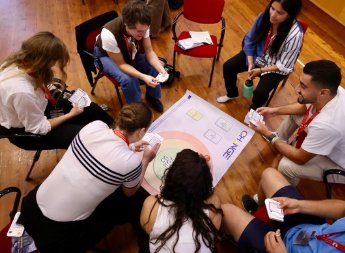
CHANGE: Cooperation for Change Management & Innovation
Project details
The CHANGE project, run from September 2022 to August 2025, was dedicated to fostering integrity and values in sport by promoting good governance. By equipping the organised sport movement with innovative governance approaches tailored to grassroots sports, the project aimed at building sustainable and innovative solutions to current and future challenges.
A key focus of the project, led by ENGSO-European Sports NGO with 10 partners, was to develop an educational program on innovation and change management. This program intends to empower the European grassroots sport movement to build resilience and promote environmental, economic, and social sustainability through digitalisation, inclusion, and engagement.
A group of experts, among others the sustainability experts of Sport and Sustainability International, reviewed the development of the interactive program and provided expert input from a sustainability perspective to support the grassroots sport movement in building a sustainable and innovative future.
https://www.engso-education.eu/change/
Resources
- CHANGE Card Game + Workshop Methodology
- CHANGE Research Reports on “change readiness” in grassroots sports
- CHANGE Podcasts
CHANGE Educational Webinars
RISE for the good in sport
Project details
In the RISE project, running from June 2022 to December 2024, sport organisations can leverage the power of sport to create positive social impact. The RISE Development Platform was developed by the consortium of specialised organisations, namely SPIN-Sport Innovation, Velcro Dev, TAKT-Together Advancing Common Trust, Opes Italia, Red Deporte Spain, and Sport and Sustainability International, to empower organisations to assess their needs and access the resources necessary to drive progress.
Regardless of their size or stage of development, organisations can utilise the RISE platform to learn, grow, and achieve recognition through the RISE Quality Label. By building strong organisational structures and developing impactful Sport for Good programs aligned with the UN Sustainable Development Goals, organisations can maximize their positive impact on society.
ZERO: Zero Emission Rides
Project details
The ZERO project, from March 2023 to February 2026, was dedicated to fostering innovative practices in grassroots snowboarding and empowering young people to combat climate change. By exploring alternative approaches to snowboarding, such as digital contests and online education, ZERO aimed to increase accessibility and participation while reducing the sport’s environmental impact.
Through workshops, training, and awareness campaigns, the project partners, led by the World Snowboard Federation, have empowered young riders and their families to adopt sustainable practices and take action against climate change. By analyzing the impact of climate change on snowboarding and exploring potential adaptations, ZERO seeked to ensure the long-term sustainability of winter sport.
https://www.worldsnowboardfederation.org/news/initative/education-sport-zero/
Resources
- ZERO Climate Education Course
- ZERO Card Game
CGG: City, Green, Go!
Project details
City, Green, Go! was a 2-year Erasmus+ project, carried out from December 2022 to December 2024, which aimed at promoting health-enhancing physical activity and environmental consciousness in urban settings by equipping relevant stakeholders, such as sports and environmental organisations and local authorities, with the tools and resources needed to organise eco-friendly grassroots sport events.
Resources
- City, Green, Go! Toolkit for eco-friendly urban sports initiatives
- City, Green, Go! Research Report on the principles for environmental conservation and regeneration in sport events and recommendations
City, Green, Go! Best Practice Collection
BOOST: Mentor Program
Project details
Across Europe, sport is increasingly recognised as a powerful tool to address societal challenges. In this context, Sport for Social Impact (S4SI) initiatives contribute directly to key EU priorities and to the UN Sustainable Development Goals. However, the proven potential of S4SI can only be fully harnessed (a) if it is provided by well-governed and healthy organisations, and (b) if their S4SI programmes are guided by clear educational concepts.
But although most sport professionals are aware of the great potential to contribute to a positive social impact in and through sport, many entry- to mid-level sport professionals still face significant challenges in translating policy ambitions into effective, sustainable and impactful practice.
Practice shows that they either (a) lack specific knowledge to design impactful sports programmes that intentionally include skills development aspects, or (b) they lack expertise in setting up and growing appropriate organisational architectures, which are needed to provide a sustainable S4SI programme offer to European sport participants. This is because sport professionals often lack access to tailored, practice-oriented professional development opportunities. As a result, many S4SI initiatives remain fragmented, short-term or insufficiently embedded in strong organisational structures.
The BOOST project responds to these challenges by designing a structured capacity building initiative that is aimed at empowering emerging leaders and practitioners in the field of S4SI. Our accelerator and mentoring programme provide personalized guidance to help entry-level professionals design, refine, develop, or strengthen a concrete initiative that uses sport as a tool for positive social impact. It allows them to connect with inspiring peers, which includes experienced sport professionals who act as their mentors.
Unlike generic coaching or personal development programmes, BOOST focuses on practical, time-bound, project-oriented learning. It means that a mentee will join the programme with a specific idea or challenge that they wish to develop. Throughout the mentoring journey, our mentors accompany them throughout this process, helping them clarify their goals, strengthen their skills, overcome barriers, and translate their vision into tangible actions and results.
Through a combination of one-to-one mentoring, group learning moments, online learning, and participation in an international community of peers, the Boost mentoring programme aims to broaden all participants’ competencies, deepen their understanding of the sector, and expand their network. It means that we also contribute to the participants’ long-term growth as sport leaders committed to social impact.
With it, we seek to enhance the professional skills and competences of sport professionals, to improve the quality, effectiveness and long-term sustainability of sport organisations and S4SI programmes, to support the alignment of grassroots sport initiatives with EU policies and the UN SDGs, and to foster a sustainable European community of practice for sport professionals seeking to boost social impact in and through sport.
Boost is funded by the European Union. Views and opinions expressed are however those of the author(s) only and do not necessarily reflect those of the European Union or the European Education and Culture Executive Agency (EACEA). Neither the European Union nor EACEA can be held responsible for them.